 Apipasta with vitamins 15kg
 Beecomplet® Spring 14Kg
 Beekeeper suit with round veil
 Oxalic acid 1kg
 Beeswax Foundation 5kg
 Fresh royal jelly 20g
 Classic honey jar 1kg comb-lines TO77 - Pack of 16 units
 Promotor L Apis 1 litre

 Share in WhatsApp
10-29.5 °C MANDATORY RANGE | 7 days TREATMENT LENGTH |
10,000 BEES AS A MINIMUM | 2 strips ONE SACHET PER HIVE |
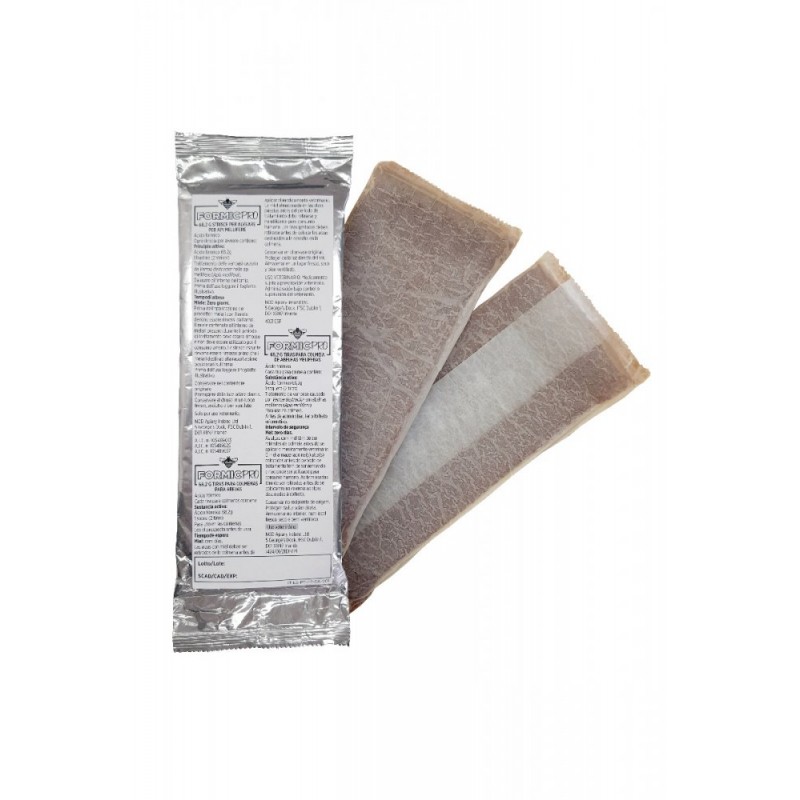
Formic acid gel strips that work by vapour and reach the varroa under the capping.
That is what sets it apart from contact acaricides: formic acidkills the mite nymphs inside the capped brood cells, not just the varroa riding the bee. And since it is not lipophilic,it leaves no residue in the comb — it occurs naturally in honey. In exchange it demands something the others do not: climate and ventilation within a narrow band.
01 · TEMPERATURE
The range is not a recommendation: the sheet lists it under contraindications. It is not used if the daytime temperature on the day of application falls outside10-29.5 °C. Going over the top during thefirst three days is what does the damage: brood mortality rises and so does the risk of losing the queen. And if that heat coincides with a dearth, the risk of queen loss, sudden supersedure or a laying halt climbs sharply. The instruction then is a single one: postpone until temperatures drop or nectar comes in again. It is not fixed by using less product.
02 · VENTILATION AND COLONY SIZE
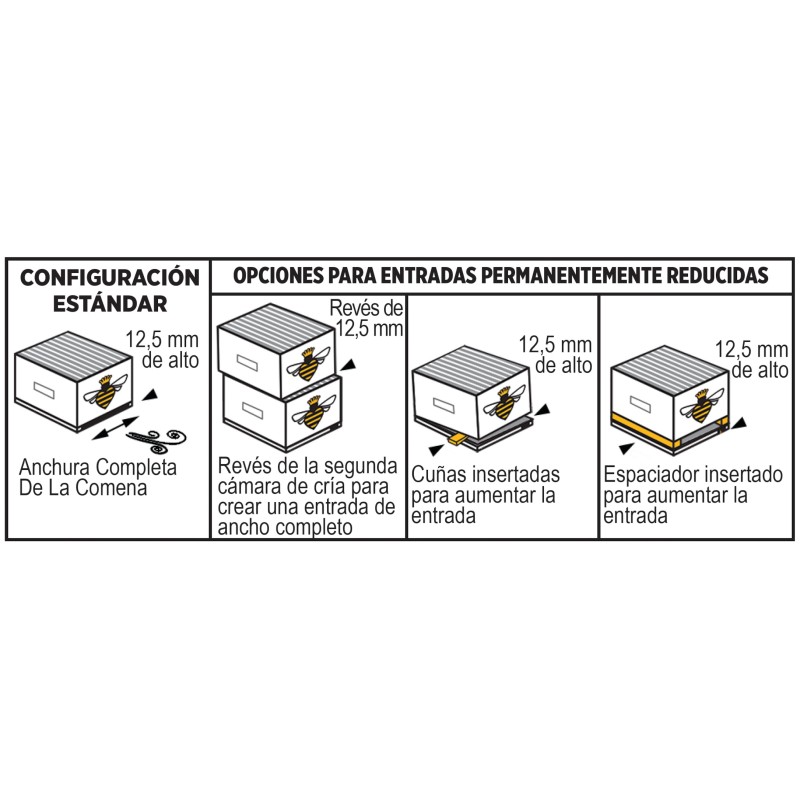
The vapour spreads because the colony ventilates the brood area down to a level it finds comfortable. That is why the sheet requiresa full-width entrance, 12.5 mm minimum height, with no reducers or mouse guards; if the entrance is permanently reduced, equivalent slots must be opened. By contrast,the mesh floor trays stay closed, which is what optimises efficacy. Hence the other contraindication:a colony of fewer than 10,000 bees is not treated, because it does not move enough air and the concentration becomes intolerable for it.
03 · HOW IT GOES IN
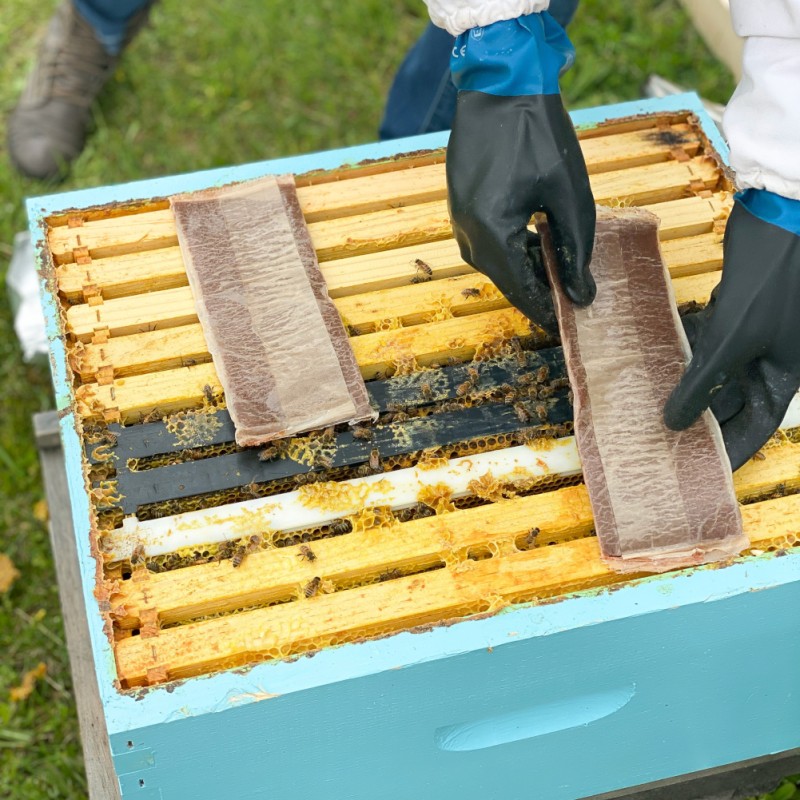
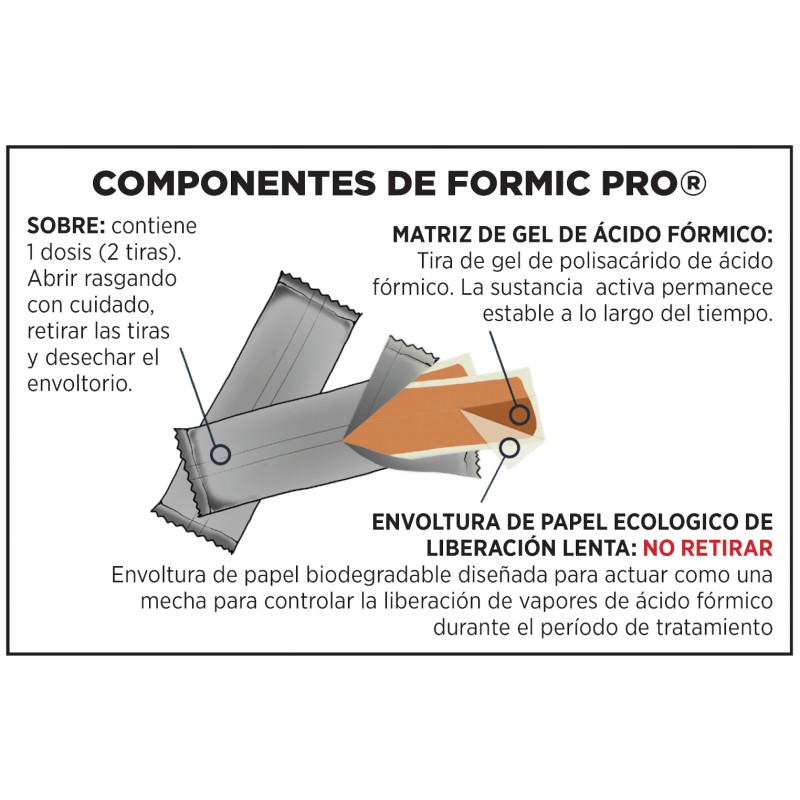
It is the most expensive mistake with this product:the paper wrapper acts as a wick and controls the release rate. You separate the two strips and lay them flat on the top bars of the lower brood box, in the heart of the brood area, with about5 cm between strips and 10 cm to the ends, with no extra spacers. One sachet —2 strips— per hive for 7 days, and aminimum of one month between applications. While it lasts, the colony is not opened: disturbing it triggers mortality of brood, adults and the queen, and can cause absconding. Spent strips are composted.
04 · SUPERS, HONEY AND QUEENS
The nuance matters.Supers with honey come off before applying, and honey stored in supers that were on before the treatment is not intended for human consumption. Spent strips are taken out before putting harvest supers back on. On the other hand, if the colony expands and needs room, empty supers can go on at application. The honey withdrawal iszero days. And on queens, an instruction that prevents a wreck:do not destroy the queen cells that appear — supersedure is natural and is best left to run. Check a month later that there is a laying queen; mother and daughter coexisting after the treatment is not uncommon.
⚠ PRECAUTIONS
It is corrosive and irritating to skin and eyes. Wear beekeeping clothing andchemical-resistant EN 374 gloves, keep water to hand and open the sachet outdoors only, standing upwind. In an enclosed space, a half or full face mask withtype B or E filters. Avoid inhaling the vapour; if it gets in your eyes, rinse for10 minutes and see a doctor. Keep children well away.
Anyone with known hypersensitivity to formic or oxalic acid should handle it with care. The colony must come to the treatment with good stores, and it is not fed inside the hive while it lasts.
05 · SUPPLY AND PACK
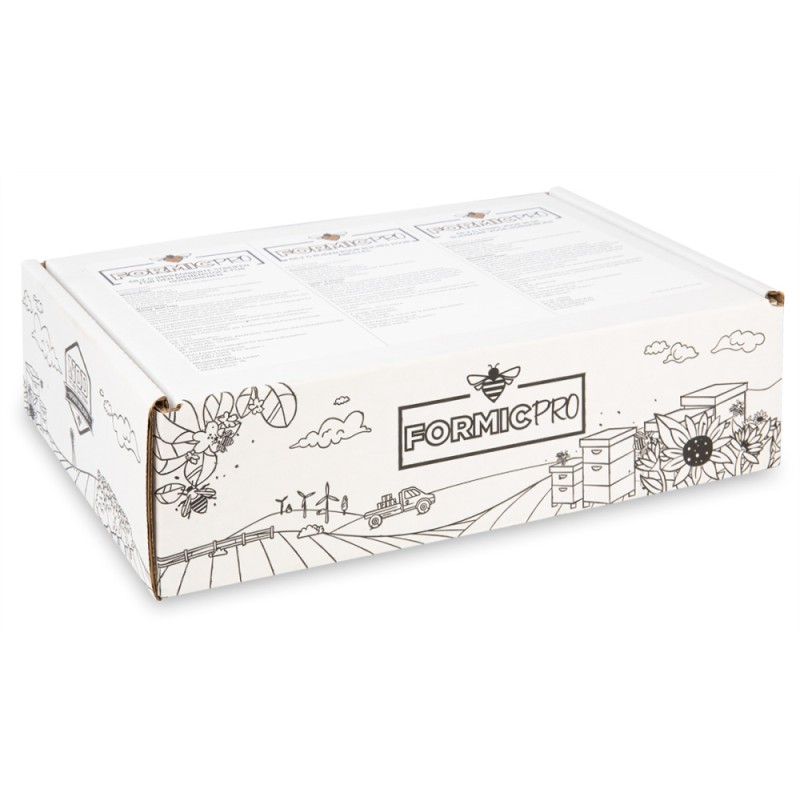
Formicpro is aprescription-only veterinary medicine and is administered under veterinary supervision or control. Because of that status itcannot be supplied by distance selling: this page is informational and does not process any purchase. This box holds10 sachets, 20 strips — 10 hives at one sachet per hive. The marketing authorisation holder is NOD Apiary Ireland Limited. Formic acid is also among the substances that Regulation (EU) 2018/848 permits against varroa in organic production; whether it fits a given certified operation is for your control authority or certifier to validate.
| ✓ FITS | Vertically modular hives —Dadant, Langstroth— with a single or double brood box, and at least 10,000 bees. |
| ✕ DOESN'T FIT | Small colonies, days outside 10-29.5 °C and supers with honey on. Inhorizontal Layens-type hives the sheet warns it has not been fully tested: only after weighing the alternatives. |
| ⚠ NOTE | The gel darkening from light brown to dark brown during storage is normal: it is caramelisation of the matrix, not a spoiled product. |
| Name | Formicpro 68.2 g strips for hives for bees |
|---|---|
| Registration no. | 4021 ESP · NOD Apiary Ireland Limited |
| Active substance | Formic acid, 68.2 g per gel strip · ATCvet QP53AG01 |
| Action | By vapour · reaches the mite nymphs under capped brood · not lipophilic, no residue in the comb |
| Dose | 1 sachet (2 strips) per hive · 7 days · minimum one month between applications |
| Contraindications | Daytime temperature outside 10-29.5 °C on the day of application · colonies of fewer than 10,000 bees |
| Ventilation | Full-width entrance, minimum 12.5 mm high, no reducers · mesh floor trays closed |
| Withdrawal period | Honey: zero days. Remove supers with honey before applying; that honey is not for human consumption. Remove the strips before putting harvest supers on |
| Pack and shelf life | Box of 10 sachets, 20 strips (10 hives) · 2 years · in its packaging, protected from sunlight, in a dry, well-ventilated place |
| Supply status | Veterinary medicine subject to prescription, administered under veterinary supervision or control |
Data sheet
check_circle
check_circle
La información de esta sección, a la que está intentando acceder, se dirige exclusivamente a profesionales veterinarios residentes en España y a las personas autorizadas para dispensar medicamentos veterinarios sujetos a prescripción.
¿Es usted profesional veterinario o establecimiento dispensador de medicamentos veterinarios?