 Apipasta with vitamins 15kg
 Beecomplet® Spring 14Kg
 Beekeeper suit with round veil
 Oxalic acid 1kg
 Beeswax Foundation 5kg
 Fresh royal jelly 20g
 Classic honey jar 1kg comb-lines TO77 - Pack of 16 units
 Promotor L Apis 1 litre
- -€24.00

 Share in WhatsApp
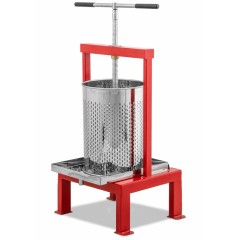
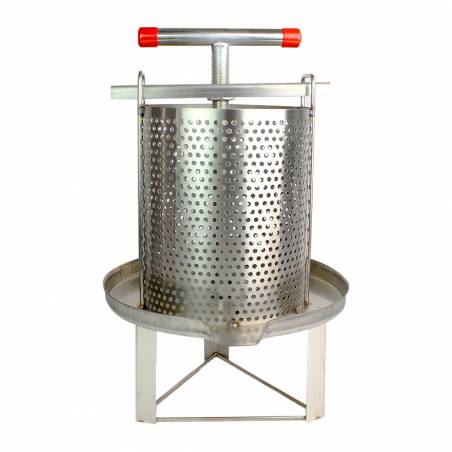
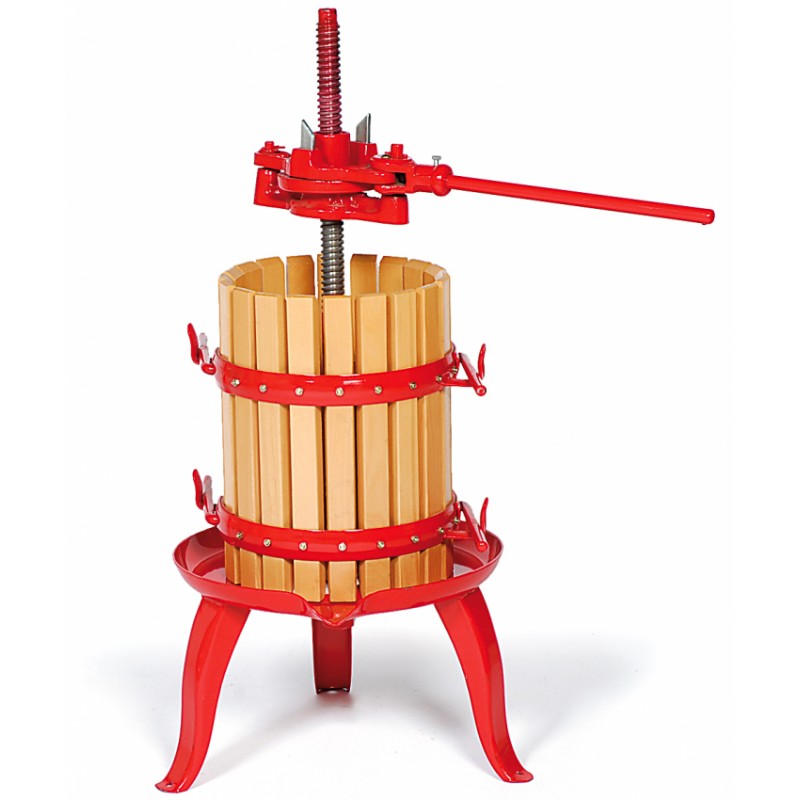
This robust manual press is an essential tool for beekeepers looking to maximize the extraction of honey contained in the cappings after the uncapping process. Designed with a screw press system and a clip mechanism that amplifies the applied force, it enables efficient honey extraction with minimal effort, even for beginners in beekeeping.
Manual press with a 30 cm basket for draining cappings and pressing whole combs. Solid build, made for regular beekeeping use.
The cappings you set aside while uncapping have honey in them. Considerably more than it looks, and that is the whole case for a press.
01 · HOW MUCH HONEY IS IN CAPPINGS
A capping is the wax lid that seals the cell, and cutting it takes honey with it. Leaving them to drain on a bench recovers some, but the wax holds the rest by capillary action and there it stays.
The press takes that fraction out. Over a season of any size, the volume of cappings is enough for the difference between draining and pressing to show in the accounts.
02 · THE ONLY WAY WITHOUT WIRED FRAMES
A comb from a Warré, a top-bar hive or a traditional skep has no wire and will not take the extractor: it collapses. For those formats the press is not an alternative, it is the method.
It is also the way when recovering honey from loose combs, from a swarm that settled where it should not have, or from frames that have broken.
03 · PRESSED HONEY IS ITS OWN THING
Honey out of a press carries more particles of wax, pollen and debris than centrifuged honey. It is not worse — many prefer it for exactly that — but it needs more careful filtering before bottling.
And one detail worth checking before you label: honey regulations recognise pressed honey as a designation of its own, defined by how it was obtained. If you are going to sell what comes out of here, check how it should appear on the label.
04 · AFTER PRESSING
What stays in the basket is capping wax, already drained — the best wax in the apiary: pale, young and free of cocoon residue. From there it goes to the boiler or the melting tank to be cast into blocks.
One handling note: there is no need to press to the limit. Past a certain point you get more wax and more impurities than honey, and you complicate the filtering afterwards.
05 · BEFORE YOU BUY
It is a manual press and it is heavy: it goes in a fixed spot in the honey house, with room to work around it.
| ✓ RIGHT FIT | Recovering honey from cappings and pressing unwired combs. |
| ✕ WRONG FIT | Replacing the extractor on wired frames: use a centrifuge. |
| ⚠ NOT INCLUDED | Filter, settling tank or uncapping bench. |
| Reference | HOLT-5069-TOP0022 |
|---|---|
| Basket | 30 cm diameter |
| Operation | Manual |
| Main use | Draining cappings and pressing whole combs |
| Unwired formats | Warré, top-bar and skep |
| After pressing | The wax goes to the boiler or melting tank |
| The resulting honey | Needs finer filtering than centrifuged honey |
This robust manual press is an essential tool for beekeepers looking to maximize the extraction of honey contained in the cappings after the uncapping process. Designed with a screw press system and a clip mechanism that amplifies the applied force, it enables efficient honey extraction with minimal effort, even for beginners in beekeeping.
check_circle
check_circle